Saturday, 25 August 2012

What I didn't see this summer


It has been a while since I have posted anything, partly as I have been on holiday and partly as I have not had any, shall we say, dance related experiences.

I did not go and see ‘Cross Connection Ballet’, which showcases winners of the Copenhagen International Choreography Competition (CICC), partly as, I confess I forgot as it was just after one of my summer trips and partly as the last time I went it was a very disappointing evening.  Judging by the review I read, I don’t think I missed much.

I also missed ‘CPH summer dance’, the open air dance performance at the main police station’s courtyard.  Although Dansk Danseteater were one of the companies performing, the weather is always so uncertain, so I just didn’t go (though in fact the weather was good most of the time).  I’ll be honest and say the programme did not look that exciting in any case, and would rather wait and see the full length pieces later on.

Also bypassed was the street dance festival, and although I have bought a ticket for Alvin Ailey next month (in the dreadful venue of Tivoli), I now cannot go (reasons to follow!).  So…quite a few dance empty weeks.

However, I did catch this delightful gem when browsing some old comedy programmes.  From 1993, it features a young Darcey Bussell as well as Anthony Dowell in a French and Saunders sketch.  It lasts about 15 minutes but worth watching.  Have fun!

Friday, 13 July 2012

Random jottings on a summer day


I’m on holiday and apart from keeping up with some of my favourite Twitter feeds and ballet blogs, not much going on here in the world of dance.  However, my old favourite BBC Radio 4 provided some dance again.  Margot Fonteyn was profiled as one of their  “The New Elizabethans” series, which profiles 60 public figures nominated to mark the Queen’s Diamond Jubilee.  The programme, narrated by James Naughtie, mixed commentary and recordings of her speaking in a brief history. 


It was a fun 15 minutes, and reminded me of my mother and the time she sat down next to Margot Fonteyn and insisted that, and here I have to admit, I am not sure what she said, that the Vic-Wells or Sadler’s Wells Ballet had danced “Polovtsian Dances”  during the 1930s when my mother was living in London.  Dame Margot said my mother was wrong (she was right, my mother was wrong), the Royal Ballet first dancing this in the 1960s.  I have wondered since who my mother saw, and need to do a bit of research.  If any one can supply an answer it would be most welcome!

You may be wondering how my mother came to be sitting next to Dame Margot.  Well, in 1975   Peter Darrell choreographed “The Scarlet Pastorale” for Margot Fonteyn, and as we (my mother and I) were Friends of Scottish Ballet, we got invited to a reception for Dame Margot.  My friend Steinvör and I were eager to get autographs, and one of the dancers (Patricia Rianne) took our programmes from us and got not only the signature of most of the company members, but also Margot Fonteyn’s.  I still remember going back to the theatre the next day to collect the programmes, and still treasure it in my collection.

This blog is not quite turning out how I had intended, it is still needing to find a direction and focus, but I can feel it is turning into a mix of memories linked to reviews.  If so, then expect blogs on programme collecting, memorable performances and other things in the future!

Picture source:  http://commons.wikimedia.org/wiki/File:Choumoff_-_Adolph_Bolm,_Polovtsian_Dances.jpg


Saturday, 30 June 2012

Mao’s Last Dancer…and a surprise connection


A couple of months ago, I finally got around to seeing the 2009 film ‘Mao’s Last Dancer’, based on the autobiography by Li Cunxin.  I really enjoyed the film, so decided to read the book.

It is a heart-warming story, told in a very simple and honest fashion.  When Li was 11, he was taken from a poor village in China to Beijing to study ballet.  His description of the process, being chosen from his classroom, going through a number of auditions and tests, and finally ending up at Madame Mao’s academy, is quite fascinating.  He had very little idea of what ballet even was, and had a fear he was going to be made to dance on pointe.  In an article I found on www.ballet.co.uk I read that whilst writing the book, Li called his former schoolteacher to ask her why she had pointed him out to the talent scouts, and she replied "I think the only reason was that you ran fast".  What a wonderful statement!  It was also interesting to read about the school and life in China during the 1970s and the importance placed on being a good communist as well as a good dancer. Li later said that if they had spent more time on dancing than politics, then they would have all been better dancers.

In 1979, he was chosen to go on a cultural exchange to Houston Ballet in Texas.  His touching naivety on arriving in the USA is understandable.  He had been fed propaganda about how poor a country the US was, and so was completely surprised by what he saw when he arrived.  He was nurtured and looked after by Ben Stevenson, the then artistic director.  A combination of falling in love and realising the freedom that dancing outside China could bring him, led him to seek asylum in the US.  He had wanted to return to China to visit his family, but this was denied, and he was held at the Chinese Consulate in Houston for 21 hours while his case was debated.  Thanks no doubt in some small way to the fact that Barbara Bush was then a patron and great supporter of the ballet, he was allowed to stay in the US, and went on to dance with the Houston Ballet.   He later married the Australian dancer Mary McKendry, and eventually moved to Melbourne, retiring from ballet in 1998, and becoming a stockbroker. 


                          Li Cunxin and Mary McKendry in the pas de deux from Esmeralda 


Of course his childhood in China and the culture shock of his arrival in the West are fascinating to read about, but perhaps the most poignant moment in both the film and the book is when his parents are allowed out of China to see him dance.  The description of their arrival at the theatre, including causing a delay in the start of the performance as their flight was delayed, cannot help to bring a tear to the eye of even the most hard-hearted.  The book is well worth reading, even if you are not really interested in ballet, as an account of a childhood and an adulthood in two very different worlds.  It is perfect for either a summer read or curling up on the sofa with in the winter.

The surprise connection occurred as I was nearing the end of the book. I sat up bolt upright as I read “Ben had chosen Janie Parker and me as his first cast and Mary was paired with Kenneth McCombie as second cast”.  Could it be the same Kenneth McCombie who went to the same ballet school as me when I was a child?  He was quite a bit older than me and one of the few boys in the school.  I turned to Google for help, and sure enough, I found that he had gone on to dance with London Festival Ballet and from there to Houston.  After retiring from dancing, McCombie moved back to Fife, where he works today for the local council.  I was also very pleased to be able to pass this on to an old friend of mine who had been discussing him recently, and had wondered what had happened to him.  What a small world we live in.


                                                          Kenneth McCombie 1978


And finally some trivia!  The parents of Chi Cao, who took the role of Li in the film, were two of Li’s former teachers at the Beijing Dance Academy.  He is a dancer with the Birmingham Royal Ballet.

‘Mao’s Last Dancer’ by Li Cunxin is published by Penguin Books.

The photo of Kenneth McCombie was taken by Daniel Sorine http://www.flickriver.com/photos/soulico/3058874130/  

And....if you want to see what happened to him...http://news.bbc.co.uk/2/hi/uk_news/scotland/edinburgh_and_east/8183342.stm


Sunday, 17 June 2012

The Good, The Bad and…..The Unknown


On Friday, I got around to booking tickets for Thomas Lund’s ‘farewell’ performance in September.  I have mentioned before that he is one of my favourite dancers with The Royal Danish Ballet.  He has a grace and elegance that fits so well with the Bournonville tradition of the company. 

So, the ‘good’ is that I managed to get tickets.  They went on sale to non season ticket holders on Thursday, and by Friday there were only a few seats left.  Another ‘good’ is that he will dance Jamie in ‘La Sylphide’, surely his signature piece.


The first ‘bad’ is that because I was a day late in booking tickets, I have not got particularly good seats.  Pity, but it will still be worth it I hope.  The other ‘bad’ is the other piece is Flemming Flindt’s ‘The Lesson’, which I really don’t like.  As well as being dated (at least I though so the last time I saw it a few year ago), it is such a dismal piece. Based on the Ionesco play, it tells the tale of a psychopathic dance teacher who abuses and kills his pupils.  Cheery stuff I am sure you agree!

And to the question mark – or rather marks.  The first question is – will the queen be there?  She often goes in a personal capacity, and with this being a special event, could well turn up.  I think I have attended performance ‘with’ her around 8 or 9 times.  Second, and more important, who is going to come with me?  I bought two tickets but have yet to ask anyone to come with me.  So, if you are in Copenhagen on 29th September and have 470 kr to spare, let me know!

Monday, 11 June 2012

It’s all about the footwork (or random jottings on a Monday evening)


Here, at least there is not that much happening in the dance world (well, there was Dansk Danseteater's open air 'Spring Dance' but the weather is not friendly to open air performances just now).   I haven't stopped reading - or indeed listening - about dance, however.

Last week I managed to catch a short documentary narrated by Deborah Bull about Pina Bausch on BBC Radio 4.   It was interesting to hear about dance and not just see it!  The programme was focused on who she was and her legacy, and obviously timed to coincide with the Pina Bausch season in London (you can read about it here http://www.barbican.org.uk/news/artformnews/theatredance/pina…).  I had wanted to hear it again before writing about it by unfortunately it was one of those programmes that are only available for 7 days. Hopefully it will be repeated at some point.

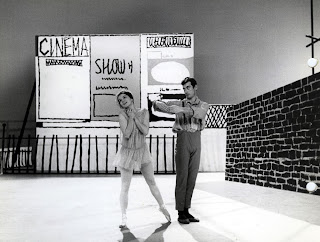
While I was on the BBC website, I  decided to do a search for ‘ballet’ to see if I could find anything interesting and one fun thing came up – this picture from 1961 of Western Theatre Ballet  in Walter Gore’s “Street Games”. Western Theatre Ballet was founded by Peter Darrell and Elizabeth West in 1957, and in 1969 moved to Glasgow, where they were first known as Scottish Theatre Ballet, eventually becoming Scottish Ballet in 1974.   


The dancers were Gail Donaldson and Peter Cazalet. Scottish Ballet is a company I grew up with, so it was kind of nice to find this.

final random note, which just must be about football, since Euro 2012 is kind of hard to escape at the moment.  Dance and football?  Well, indeed, yes.  There has been much written and discussed about the benefits of footballers learning plies and pirouettes to improve their agility, strength and – dare I say it – grace.  It helps to improve their footwork, which 'is what it is all about' or so I have been told!  There has even been a ballet about football, namely English National Ballet’s ‘The Beautiful Game’ from 2008.  You can listen to this review from ‘The Guardian’

I leave you with the thought of Zlatan Ibrahimovic learning battement frappeé.........


Sunday, 3 June 2012

From Darkness into Light


It was with great misgivings that I went to the last programme this season by the Royal Danish Ballet.  If you have read previous blogs, you know why.  However, I was determined to go to see Wayne McGregor’s ‘Chroma’ on stage rather than on You Tube (if you want to see it, there is a wonderful film of The Royal Ballet performing it).  It was also nice to go to Skuespilhuset down by the water and opposite the Opera House as a change of venue.

‘Chroma’, first performed in 2006, opened the evening.  It is a piece for ten dancers and, for a bit of trivia, is McGregor’s only piece for the Royal Ballet which is performed completely off pointe and was put together in 3 weeks (thanks  http://www.theballetbag.com/ for that!).  The wonderful, minimalist set is designed by the architect John Pawson and resembles a frame or square box through which dancers enter the stage. The music is by Joby Talbot, which includes some tracks by Jack White.  

I have to say I was pleasantly surprised and thoroughly enjoyed the performance.  It truly is a wonderful piece, full of fantastic shapes and wonderful choreography the jolts you out of complacency and reminds you just how wonderful dance can be.  I can say in all honesty that it is the best piece I have seen this year, and I know it will stick in my mind for a long time.  The set, music and movement all came together in perfect harmony.
In terms of the dancing, all credit to relative newcomer Sebastian Haynes, who has the makings of a fine dancer.  Alban Lendorf was also performing.  I know I go on about him, and while I cannot fault his technique as I have said before, he is far from graceful and looks, as my companion said ‘too much like a boxer’ in his physique.  However, he is bound to have a long and successful career, and I read somewhere that he is someone who could get snapped up by another company.


                                  Edward Watson and Alina Cojocaruin of The Royal Ballet in 'Chroma'


The second piece of the evening was ‘DEW’, a new piece (premiered during this season) by Danish choreographer Tina Tarpgaard.  Her pieces often involve fantastic use of light, with motion tracking cameras and software that monitors the movements of the dancers and responds with video that corresponds to the movement.  Her piece ‘Frost’, created for Dansk Danseteater, used this to great effect.  As a piece of theatre, it was really good, with interesting shapes, textures and colours appearing and blending into each other.  As a piece of choreography, it was dull, unimaginative and made far too much use of those old contemporary standbys, waving arms about and crossing the stage not really doing anything (there was a lot of floor rolling about as well, but that was to make use of the light effects).  

After the second interval (there were three!), we were treated to my second favourite piece of the evening, ‘Impénétrable songe’.  The choreography was by Patrick Delcroix, a former dancer and choreographer with Nederlands Dans Teater.  This was also a brand new piece.  The back-drop was a flowing curtain, sometimes moved by the dancers and incorporated into the movement to great effect.  I will say, it did remind me quite a bit of Nederlands Dans Teater’s style, which was probably why I liked it so much.  There were some wonderful shapes and movements that kept you interested and captivated.  The dancers were also in good form for this (I saw Gudrun Bojesen, Gitte Lindstrøm, Alba Nadal, Amy Watson, Ulrik Birkkjær, Jonathon Chmelensky and Tim Matiakis).


                                  Amy Watson and Jonathon Chmelensky in 'Impénétrable songe'


The final piece of the evening was ‘ergo ubi NARCISSUM per devia rura vagantem’ (yes – that is the title – I have not made some typos!).  Choreography was by Yuri Possokov (ex Bolshoi, ex Royal Danish Ballet, now San Francisco Ballet where he has been chief choreographer since 2006).  The music was various bits of Handel, and sung by Andrea Pellegrini, who was also present on the stage.  The scenery was composed of a large ball that reflected the dancers and formed, like the sets with the other three pieces, an integral part of the piece.  This was my least favourite of the evening, partly because of the singer on the stage (always far too much of a distraction) and partly because I found it rather pedestrian and unoriginal, though it certainly strived to be so.  There was just too much going on and, if I may say so, struck me as being just a little pretentious. 

Still, overall it was a good evening and at least I feel I have finished the season with something enjoyable and well worth seeing.  There seem to be some new dancers coming up that will be worth watching in seasons to come, and perhaps we will see some good things in the future.  I have looked at the programme for the coming season, and see the truly dreadful production of ‘Sleeping Beauty’ is being resurrected along with the natural quota of Bournonville.  Thomas Lund is due to retire next season, so I really hope I can get to see him one more time.  In the meantime, over the summer I hope to catch some bits and pieces of dance, read a biography of Balanchine and reflect over some issues that I think interesting when going to see a dance performance.  

PS – Linguistic note for those of you interested.  The evening was called ‘Sidste skrig’ which literally means ‘last shout’, but which also means ‘cutting edge’, both meanings in fact make perfect sense!

Sunday, 20 May 2012

Where to sit? The view from the audience

-->
I mentioned in an earlier blog that I was going to say something about where to sit to watch dance.  This is one of those topics that I will confess I have changed my mind about several times over the years.  I guess the truth is that you need to try out different locations until you find what you like and don’t like, and to keep in mind that theatres are all different, so what works in one might not be so good in another.  Always go for the best you can afford in any case.  There is nothing, however, that can be done about predicting who is going to sit in front of you (or indeed, behind you)!

In a traditional theatre, the first issue to address is stalls, circle or upper circle.  There was a period where I always sat in the stalls, as I wanted to be able to closely watch the feet and to be able to see the details of what was going on.  A friend of mine convinced me of the joys of sitting upstairs, from where you can see the patterns and shapes more clearly, and so for several years I always went for the circle or upper circle.  Well, here we have to consider a number of things.  Firstly, too far ‘up in the Gods’ and you probably won’t see anything (for example, I once went to see a Polish company in a piece that featured nudity, and I was so far back I couldn’t tell who were the men and who were the women…well, almost!).  Secondly, in some theatres like Gamle Scene in Copenhagen, there are many seats with an obscured view in the upper parts of the theatre.  If you suffer from vertigo, then some upper circle seats are really not for you (again, some of Gamle Scene).  More modern theatres such as the Festival Theatre in Edinburgh and the Opera House in Copenhagen have good seating upstairs, though watch out as in some big theatres, you will feel you are a long way from the stage and can feel a bit detached from the performance. 

The last two pieces I have seen have been in the stalls, and I have regained my fondness for that place in the theatre.  The front stalls in particular are a great place to sit.  For example, when I saw the Dance Theatre of Wuppertal’s ‘Rite of Spring’, I was so close I could smell the earth on the stage the dancers were performing upon.  However, I was glad I was upstairs when I saw Nureyev in ‘Prodigal Son’, the sweat trails on the stage would probably have been even worse close too!

This brings us to the type of performance space often used by contemporary companies, what I call the scaffolding and wobbly step type of seating.  This varies a lot from the good, such as I have experienced at The Tramway in Glasgow, to the sort where you wonder if you will end up falling through the seating during the performance.  It is best not to go for the front two or back two rows in my opinion if you don’t want to be part of the performance either by being too close or sitting right beside the people doing the lights.  It is particularly fun if the scaffolding is used as part of the performance, such as during a talk I once went to by Merce Cunningham which at one point included John Cage walking about underneath the seats, banging on the metal, creating rhythms for dance.

Finally, there are some venues that should not be used for dance, such as The Concert Hall in Tivoli, Copenhagen (which won’t stop be going to see Alvin Ailey there in September I may add).  It is also risky performing outside when in northern Europe, though sometimes it is glorious, when the sun is shining and the costumes billow in the wind.

So…my advice is experiment, get to know the theatre you are going to if possible, and keep your fingers crossed that there are only short people in front and no badly behaved children behind!

(Footnote – one of the most intriguing performances I have seen was Tim Rushton’s ‘Labyrinth’ where we as the audience walked around, almost interacting with the dancers, who danced in separate spaces.  That gave quite a different perspective of dance).